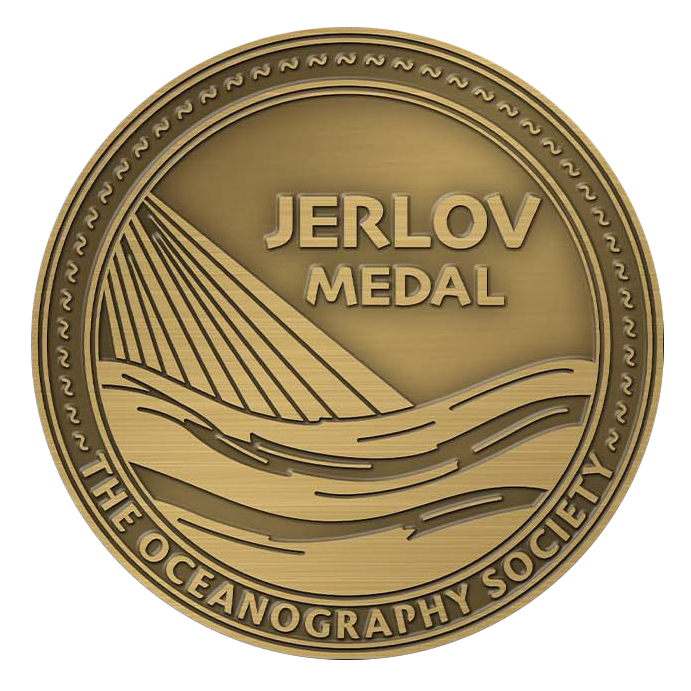
THE JERLOV MEDAL
The Oceanography Society commemorates Dr. Nils Gunnar Jerlov and his many contributions to the study of light in the ocean with an international award, given biennially, to an individual for advancing our knowledge of how light interacts with the ocean. Additionally, the Jerlov Medal also seeks to recognize individuals who have made significant contributions toward educating and mentoring students and early career ocean professionals or who have conducted significant interdisciplinary research in ocean science and/or collaborative work towards meaningful societal impact. Learn more
PLENARY 4 –
Progress and Gaps in Ocean Color Remote Sensing of Coastal Water
2026 Jerlov Medal Recipient — Zhongping Lee
Thursday, September 17, 09:00–09:45
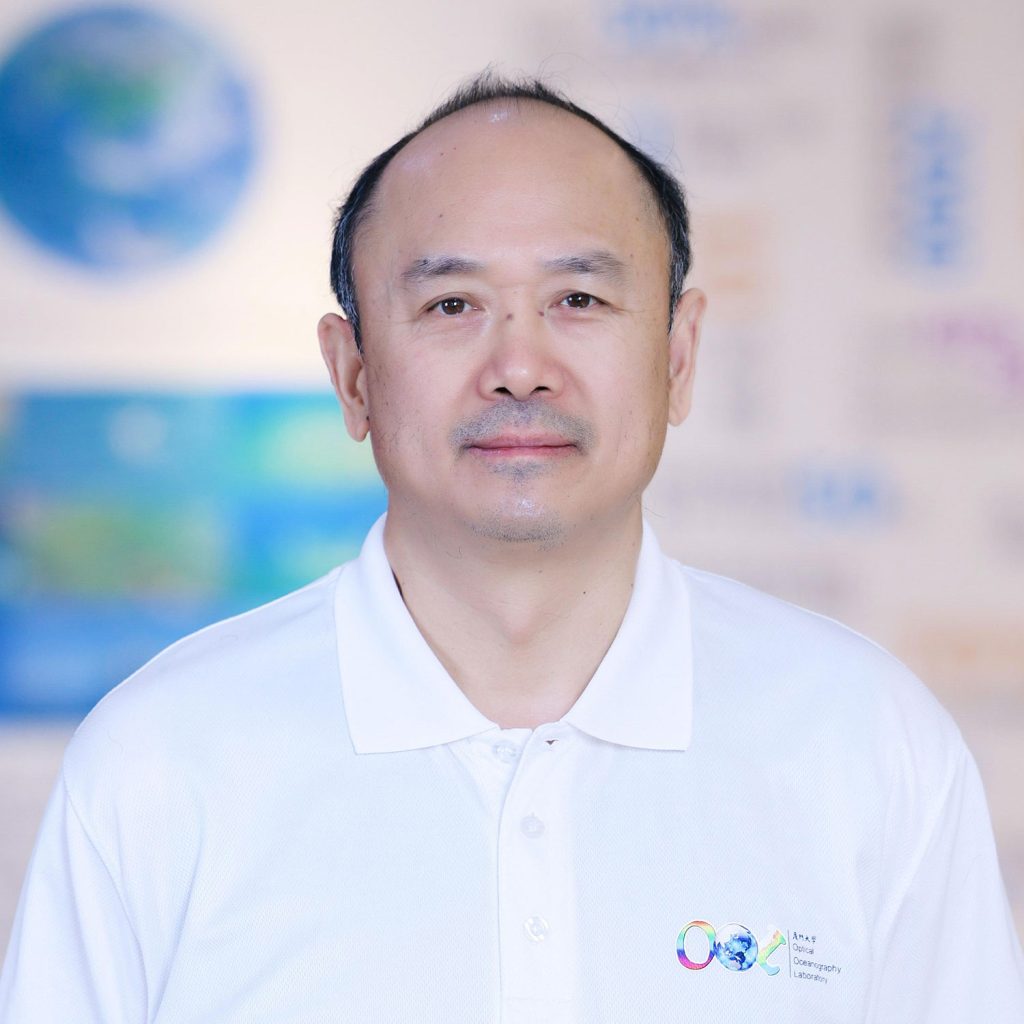 2026 MEDAL: Dr. Zhongping Lee
For his breakthrough in water transparency theory and outstanding contributions to the advancement of ocean color remote sensing
The Oceanography Society has selected Dr. Zhongping Lee of Xiamen University as the recipient of the 2026 Nils Gunnar Jerlov Medal, recognizing his transformative contributions to understanding how light interacts with the ocean, as well as his sustained leadership in education, interdisciplinary research, and collaborative work with meaningful societal impact. Dr. Lee will be recognized at The Oceanography Society Honors Breakfast, February 24, 2026, during the Ocean Sciences Meeting in Glasgow, Scotland, as well as during the Ocean Optics XXVII Conference in Ghent, Belgium, in September 2026.
Awarded biennially, the Jerlov Medal honors individuals whose work has fundamentally advanced ocean optics and its applications. Over more than three decades, Lee’s research has reshaped the theoretical foundations and practical implementation of ocean color science, enabling robust global observations of ocean transparency, productivity, and optical properties from satellites.
Nominating letter author Chuanmin Hu of the University of South Florida, summarized Lee’s career as that of “a pioneer, a leader, an optical theorist, a practitioner, and an educator,” emphasizing that his influence extends “beyond our generation.” With more than 200 peer-reviewed publications and thousands of citations, Lee’s work continues to shape satellite missions, operational products, and the scientific understanding of how light governs ocean processes.
Advancing the Science of Light in the Ocean
Central to Lee’s impact is his pioneering shift toward an inherent optical properties (IOP)–centered framework for ocean color remote sensing. This physics-based approach replaced empirical, chlorophyll-centered methods with models grounded in radiative transfer, dramatically improving accuracy and global applicability. His Quasi-Analytical Algorithm (QAA) for retrieving absorption and backscattering of water constituents from satellite observations is now used operationally by NASA, NOAA, and ESA.
Curtis Mobley, Emeritus Vice President at Sequoia Scientific, Inc., highlighted Lee’s willingness to challenge long-standing assumptions, particularly in water transparency theory. “Zhongping had the courage to question the approach of the great master and the radiative transfer skills needed to develop a new and better algorithm for prediction of the Secchi depth,” Mobley wrote, noting that Lee’s work is now “widely used as a way to estimate the optical penetration depth of the upper ocean from satellite ocean color spectra.”
Lee’s revised theory of Secchi disk depth replaced the decades-old paradigm and established a direct, mechanistic link between water transparency and diffuse attenuation—an advance that made global satellite-based transparency products possible. These products are now adopted operationally, providing critical insights into water transparency and ecosystem change.
Interdisciplinary Impact and Societal Relevance
Beyond theory, Lee’s work spans optically shallow-water remote sensing, sensor design, and precise field measurements of water-leaving radiance. His physics-based algorithms for bathymetry and benthic mapping support applications ranging from coral reef monitoring to coastal management and security. David Antoine of Curtin University described Lee as a scientist who “did not bend when he thought he had to challenge established concepts,” adding that his breakthroughs have “led to significant debate and further studies,” a hallmark of influential science.
Antoine also underscored Lee’s collaborative spirit and community leadership, citing his “friendly behavior and his willingness to listen to and exchange with others,” qualities that have helped build “connected, collaborative, and resilient research communities.”
Educator and Mentor to the Field
In addition to his research achievements, Lee has made lasting contributions to education and mentoring. He has trained numerous graduate students and postdoctoral researchers and has been a cornerstone instructor for the International Ocean Colour Coordinating Group (IOCCG) Summer Lecture Series. He also founded and organized recurring ocean optics and ocean color summer schools in China, collectively training hundreds of postgraduate students and early career scientists.
Through his groundbreaking research, collaborative leadership, and dedication to training the next-generation scientists, Zhongping Lee exemplifies the goals of the Nils Gunnar Jerlov Medal. His selection as the 2026 recipient recognizes a career that has fundamentally advanced ocean optics and delivered enduring scientific and societal benefits.
PREVIOUS Recipients
2024 – Dariusz Stramski
2020 – Edward S. Fry
2018 – Annick Bricaud
2016 – Curtis Mobley
2014 – George W. Kattawar
2012 – Kendall L. Carder
2010 – Charles S. Yentsch
2008 – Talbot Waterman
2006 – J. Ronald V. Zaneveld
2004 – Howard R. Gordon
2002 – Raymond C. Smith
2000 – André Morel